Gladstone Guest, Rotherham United footballer

Gladstone Guest (1917-1998) was a professional footballer who played for Rotherham United between 1946 and 1956. He scored 130 league goals (still a record for the club) in 358 league appearances and 133 goals altogether (2nd place, in 375 appearances). https://en.wikipedia.org/wiki/List_of_Rotherham_United_F.C._players

Gladstone’s early life

Gladstone was born on 26 June 1917 to Isaac and Ruth Guest, and baptised at All Saints Rotherham (now Rotherham Minster) on 11 July 1917. His father Isaac was a miner and the family were living at 50 Warden Street, Rotherham.

Isaac Guest had married Ruth Greenwood in the Rotherham area in 1913. They had 5 children, and Ruth also had 4 children from her first marriage.

50 Warden Street was still home to Isaac and Ruth:

  • in 1921, with Gladstone and other children Winifred (8) and Cyril (3), as well as Ruth’s children Gladys Tye (17), Ernest Tye (15) and William Tye (13) with her 1st husband Ernest Tye.
    Ernest Tye had died in the 3rd quarter of 1910. Winifred’s birth was registered in the name Winifred G Tye in the 4th quarter of 1912 and her marriage certificate (1933, in the name of Winifred Tye Guest) names Isaac as her father.
  • in 1939, with son Eric (14, page boy) and another person (listed above Eric) whose entry is still redacted out.

Isaac was a steel worker in 2021 and a steel rod examiner in 1939.

Gladstone’s:

Thanks to Valerie Ayris for telling me about Gladstone, who I had never heard of. She also supplied this picture of him.
Valerie is Gladstone’s 2nd cousin twice removed, and my 4th cousin once removed.

Marriage

Gladstone married Kathleen Annie Kime in the Rotherham area on 12 July 1947 at Rotherham Parish Church. He was still living at 50 Warden Street (Canklow) and she was at 45 Warden Street, where the Kime family had been living when she was baptised in 1921. The witnesses were Cyril Guest (presumably Gladstone’s brother) and Enid Meadows.

Gladstone and Kathleen apparently had no children.

Football career

Much of the information I have found about Gladstone was in his obituary (published in the Yorkshire Post on 21 July 1998), and in press reports in the Star Green ’Un (a Sheffield sports paper) and the Retford, Worksop, Isle of Axholme and Gainsborough News. There are also reports about some of his matches for Denaby United at https://conisbroughanddenabyhistory.org.uk/?s=gladstone+guest

Gladstone’s played initially for Worksop Town (needing a 3-hour bus trip from his home in Rotherham). He was highly rated: the manager of First Division Portsmouth arrived in 1938 in an attempt to sign him in, but arrived a couple of hours after Gladstone signed as a professional for Rotherham United in 1938 (aged 21). Because of World War 2, he didn’t make his debut until 1946, when he was 29.

Rotherham United was formed in 1925 by the merger of Rotherham County and Rotherham Town. The team is nicked the Millers, presumably because they played at Millmoor from 1907 to 2008. The club’s website is https://www.themillers.co.uk/

War record

Gladstone served with the Highland Division in North Africa, the Middle East and Crete, and landed in France the day after D-DAY.

While serving, he played for Rotherham Welfare. He also watched a Watford match and played several games for them after answering an appeal to the crowd for any professionals who happened to be watching.

Back to Rotherham United

Gladstone was an inside forward. A report on the first post-war league match between Rotherham and Sheffield Wednesday described Guest as a ‘master tactician who deployed his forces with a skill that repeatedly prised the Wednesday defence wide apart’.

A 1951 report in the Daily Mirror says that Gladstone was one of 3 part-time Rotherham United players employed at the local steel works, with another 7 full -time professionals having previously worked in local pits.

In 1950, Manchester United, Sheffield United and Huddersfield Town all offered large fees, but Rotherham refused to release him. Instead, the club made him captain.

In 1953, Rotherham United stopped Newcastle United Newcastle from winning the FA Cup for the 3rd time by beating Newcastle 3-1 in the 4th round. Gladstone delivered an assist for the 3rd goal.

As captain, he led Rotherham United to victory in the Third Division North in 1951 (squad picture with the trophy at https://www.themillers.co.uk/news/2025/july/01/1950-51-title-winners/). He then led them to their highest ever league position in 1954-55, being denied promotion to Division One (today’s Premier League) only by goal average—after missing a penalty in the last match.

After professional football

Gladstone finished his playing career with Rotherham United in 1956, continuing as groundsman until his retirement in 1962. He also played high-standard amateur football for many years, for Gainsborough Trinity FC and then for Denaby United (near Doncaster). Some press reports of matches for Denaby are archived at https://conisbroughanddenabyhistory.org.uk/?s=gladstone+guest

He returned to Gainsborough as player-manager between 1961 and 1963. Gladstone managed Gainsborough Trinity from 1961-3. Well known managers of the club in later years included Neil Warnock (1980-1), Leighton James (1993-4) and Brian Little (2009-2011).

He was also a scout for Sheffield United in 1972 (and presumably in other years as well).

Other sports

Gladstone played cricket regularly in the summers. In 1963, he topped the batting averages for Jenkins Sports of Rotherham in the Doncaster Senior League, scoring 460 runs in 10 innings (4 not out), with a top score of 120 not out.

In 1964, Gladstone was picked to play in a benefit match against a Yorkshire all stars team that included current and future Yorkshire captains Brian Close and Ray Illingworth, fast bowler Fred Trueman and Leeds United football manager Don Revie. He was also picked for a Doncaster Cricket League X1 in their annual match with a Yorkshire Council X1.

In 1982, a newspaper reported him as having a black eye (at the age of 65), caused by a cricket ball deflecting off a top edge.

Gladstone also won Army boxing and snooker titles.

Death

Gladstone died on 17 July 1998.

Families of Little Cressingham (1): my ancestors

I’ve previously summarised 1841 census information for each household in Little Cressingham (Norfolk). (that census also covers Threxton).

That summary was set out in the same order as the census schedules. I’m now further summarising that census information by family. I’ll start by summarising the families related to my ancestors. In future posts, I’ll summarise the other families.

The census recorded 244 people in total, listed on 5 pages and grouped in 60 households. I’ve given each household a reference number from H1 to H60.

My ancestral families covered in this post are Bird and Newton. The post covers 8 of the 60 households.

Bird

My 4 x great grandmother Mary Bird (née Pooley, 1761-1842) was in H41 with her granddaughter Sally Crow.

Mary Bird’s son Adam Bird and his 2nd wife Charlotte Newton (my 3 x great grandparents) were in household H5, with 2 young daughters . https://birdsofcressingham.wordpress.com/2020/11/16/adam-bird-and-charlotte-newton
The parents of Adam Bird’s first wife (Hannah Carter) were Christopher and Mary Carter (H26).

Adam’s widowed sister Sarah Crow (née Bird, 1789-1866) was in H53 with children Mathew, John and Catherine. Sarah’s:

  • son John Crow later married Mary Markwell (H10, daughter of the family in H47.
  • Catharine Crow went on to marry widower John Pratt (a thatcher of Great Cressingham, and cousin of Jeremiah Pratt of H24).
  • son William Crow was in H38;
  • daughter Sally was with her grandmother Mary Bird (née Pooley) in H41; and
  • married daughter Marianne was in H54 (with Marianne’s husband Joseph Buckle and their 2 children). Marianne’s daughter Rachel Buckle and son James Buckle went on to marry their 1st cousins James Crow and Martha Crow, children of Marianne’s brother Matthew. https://birdsofcressingham.wordpress.com/2026/04/18/double-cousin-marriage-among-cressingham-crowes/

Sarah Crow went on to marry Robert Chapman of H3 in 1852. I don’t know whether Robert was related to Mary Pooley’s mother Anne Chapman, or to the other Chapmans in Little Cressingham in 1841.

Newton

Robert Newton and his wife Hannah Bullard were in H19, with son Robert and agricultural labourers Samuel Adcock and William Howard. Robert’s nieces and nephews included:

  • my 3 x great grandmother Charlotte Bird (née Newton, H5), daughter of Thomas Newton (1789-1849, of Great Cressingham).
  • John Bilverstone (H22) and Martha Thilthorpe or Thimblethorpe (née Bilverstone, H8), both children of Jemima Newton (1770-1862) and Robert Bilverstone.

I don’t know whether Charlotte Newton’s mother Mary Newton (née Bensley), from West Bradenham, was related to Isaac Bensley of H25.

Robert Newton and Hannah Bullard’s son Robert Newton went on to marry Lucy Bailey of H49 and they emigrated to Australia.

It isn’t clear who Samuel Adcock or William Howard were.

More about Thomas Shillito’s will

I have written before about the will of Thomas Shillito, an innkeeper of Scrooby (Nottinghamshire). https://birdsofcressingham.wordpress.com/2021/08/20/thomas-shillitto-inkeeper-of-scrooby/

I based that earlier post on an Inland Revenue summary of the will for estate duty purposes. I have now seen the will itself and this fills some gaps in my knowledge. Most importantly, the will states that 2 of the beneficiaries (Elizabeth White Shillito and Mary Ann Shillito) were daughters of Thomas’s son Samuel Shillito.

The will also states that:

  • Samuel was deceased.
  • Elizabeth and Mary Ann were Thomas’s two grandchildren, implying that they were Thomas’s only (or only surviving) grandchildren.  

This extra information makes it clear that Samuel, Elizabeth and Mary Ann were the family I discussed in my earlier post.

Timeline for Samuel Shillito

I can now confirm the following timeline for this Samuel Shillito:

  • baptised on 23 February 1771 in Harworth (3 miles west of Scrooby), son of Thomas and Elizabeth Shillito.
  • married Elizabeth White by licence on 29 December 1792 at St Mary Lambeth (south London), when Elizabeth was residing in that parish and Samuel was in St Gabriel, Fenchurch (central London).
    The witnesses were Robert Dinsdale, Mary Reynolds, and Letitia Reynolds. They signed with their names, and so did the bride and groom.
    (The parish church of St Gabriel burned down during the Great Fire of London and was never rebuilt.)
  • baptisms at St James, Clerkenwell, Middlesex (central London) of daughters Elizabeth White Shillito (1795) and Mary Ann Shilllito (1797).
  • died before 31 July 1807, when Thomas Shillito made his will. This fact proves that this Samuel was not the Samuel Shillito who emigrated briefly to South Africa in the early 1820s with his wife Isabella Winks and their children. https://birdsofcressingham.wordpress.com/2021/08/13/unsuccessful-attempt-to-settle-in-south-africa/

I haven’t found Samuel, his wife Eizabeth or their daughter Mary Ann after 1797.

Elizabeth White Shillito

Elizabeth White Shillito seems not to have married. She appears on the census:

  • in 1851 in Clapham Common (south London) as a servant and companion to widow Sarah Fauntleroy, a 78-year-old annuitant living with Sarah’s adult children  
  • in 1871 at 36 Park Road, Clapham as lodger (occupation: ‘independent’) with John Beeching (a baker from Charing, Kent), his wife Jane and their daughter Elizabeth.

I haven’t found Elizabeth in the census for 1841, 1861 and 1881. She died on 17 January 1882, aged 88 and was buried at West Norwood cemetery (south London).

Other useful information in Thomas’s will

Thomas Shillito’s will gave me some other information:

  • the bequest to granddaughters Elizabeth and Mary Ann was £25 each, not 25% each of the residue, as I had originally understood.
  • Thomas bequeathed the residue (after bequests of £100 each to sons George and William, £150 to son Richard and £25 each to the granddaughters) to his widow Elizabeth for her lifetime, and then to their son George.
  • Thomas bequeathed to George a house Thomas had built in Ranskill (2 miles south of Scrooby).
  • the estate included 5 other houses built by Thomas and occupied by tenants George Mallender, William Skelton, George Steemson, William Nettleship and William Steemson.

Who was Thomas Shillito?

Thomas Shillito and Elizabeth Clawson married in Harworth in 1763 and had 4 children (Thomas, George, Samuel [1768-1770] and another Samuel) there between 1763 and 1771. They then had 2 children (John and Richard) in Torworth (half a mile from Ranskill) between 1773 and 1775 and 2 more (Septimus and William) in Ranskill between 1778 and 1781.

All 8 children were boys. Conveniently, Septimus’s name confirms that he was indeed the 7th child.

Thomas’s will doesn’t mention his sons Thomas, John or Septimus, so presumably they had died by 1807.

I haven’t found Thomas’s sons Richard or William after their baptisms (except for the mention in the will which suggests they were still alive in 1807).

Thomas’s son George and George’s children Thomas, Samuel and Mary were at Scrooby House in Scrooby in 1841. https://birdsofcressingham.wordpress.com/2023/10/04/three-boys-with-the-same-name-died-within-5years/

Conclusion

It seems highly likely that the following 3 people were related to each other:

I don’t yet know:

Nicking birds

According to a report in The Kensington News for 2 September 1882, Charles Povey (a labourer of (Gloucester Laundry, Kilburn Lane) was sentenced to one month’s imprisonment for stealing 2 pigeons. The birds were the property of Thomas Ball of 15 P Street, Queens Park.  

From the location, dates and occupation, I suspect this might well be my 2 x great grandfather Charles Povey (1842-1901) or his son Charles Povey (1866-1950).

Charles senior was a laundryman and his wife Elizabeth Herbert was a laundress. The family were living in 1881 at 2 Little Church Place (Queen’s Park Church Place, near Kensal Town – Birds of Cressingham). Charles (junior) ‘works with bookbinder’.  

P street (now known as Peach Street A-Z New to Old Street names), Kilburn Lane and Little Church Place (now St John’s Terrace) are within a few minutes walk of each other.

By 1891, Elizabeth had died and Charles (senior) was in Chelsea Workhouse Infirmary.

I haven’t found Charles (junior) in 1891. He married Emily Harman in 1896, when he said he was a labourer, living in Kensal Road (at number 198). Kensal Road was where many of the Clarks and Poveys lived. Another Clark connection in Kensal Road – Birds of Cressingham

For more on:

Double cousin marriage among Cressingham Crowes

    Matthew Crowe’s son James Crowe married his cousin Rachel Buckle, daughter of Matthew’s sister Marianne Crowe. And Matthew’s daughter Martha Crowe married Marianne’s son James Buckle.

    The parents of Matthew Crowe (1818-1905) and Marianne Crowe (1814-1856) were William Crowe (1779-1837) and Sarah Bird (1789-1866). Sarah was a daughter of my 4 x great grandparents James Bird (1765-1826) and Mary Pooley (1761-1842). All these people lived in Little Cressingham (Norfolk).

    For more on:

    I discuss below:

    • places mentioned in this post
    • Marianne Crowe (1814-1856) and Joseph Buckle (1814-1898)
    • Matthew Crowe (1818-1905) and Mary Grey (1821-1881)
    • James Crowe (1846-1916) and Rachel Buckle (1841-1874)
    • James Buckle (1846-1930) and Martha Crowe (1850-1899)
    • DNA

    Some records spell the name as Crowe but others spell it as Crow. For simplicity, I have used Crowe throughout this post.

    Places mentioned in this post

    The parish surrounding Little Cressingham include Great Cressingham, Saham Toney, Threxton, Stanford and Hilborough. Beyond Saham Toney are Watton and then Carbrooke.  Thetford is about 10 miles south of Little Cressingham.

    Marianne Crowe (1814-1856) and Joseph Buckle (1814-1898)

    Marianne Crowe was baptised in Little Cressingham on 8 May 1814 (when her father William Crowe was a lime burner). She married Joseph Buckle there on 31 July 1836. The witnesses were Adam Bird (presumably her uncle, my 3 x great grandfather), [the mark of] Mary Crowe, and Christopher Carter.

    The couple and their children were in Little Cressingham in 1841 (in the household I have labelled H54, next door to Marianne’s parents William Crowe and Sarah Bird of H53) and 1851. Joseph was an agricultural labourer. People of Little Cressingham (5) – Birds of Cressingham

    Marianne and Joseph had 5 children:

    • John Buckle (1838-1907). Married Esther Moore (of Hilborough, 1839-1877) on 8 January 1859 in Hilborough. Coal merchant in Watton (1881 and 1891). With 2nd wife Emma Jane Walker (from Norwich, 1859-1941?) by 1891. Died 23 October 1907 residing in Watton. Probate to widow Emma Jane, effects £4077 3s 2d. 3 children with Esther and 1 with Emma Jane.
    • William Buckle (1840-1893). Married Martha Gamble (from Great Cressingham) in 1868. 5 children.
    • Rachel Buckle (1841-1874). See below.
    • Joseph Buckle (1844-1993). Married Elizabeth Cockerell on 22 May 1868 in Little Cressingham. Witnesses William Buckle and Mary Cokerill. 7 children. In Little Cressingham in 1871 and 1881, in Hilborough 1891 (a carter).
    • James Buckle (1846-1930). See below

    Joseph Buckle (1814-1898)

    Marianne Crowe’s husband Joseph Buckle (1814-1898) was baptised in Little Cressingham on 10 April 1814, son of John Buckle and Susannah. This couple may be John Buckle of Stanford and Susan Easter, who married in Threxton on 10 March 1800.

    Matthew Crowe (1818-1905) and Mary Grey (1821-1881)

    Matthew Crowe was baptised in Saham Toney on 23 March 1816. In 1841, Matthew was with his widowed mother Sarah in Little Cressingham.

    Matthew married Mary Grey (1821-1881) of Saham Toney in that parish on 18 October 1844.  Matthew lived the rest of his life in Little Cressingham, though the 1861 census seems to show the couple in the neighbouring parish of Threxton.

    Matthew and Mary had 7 children:

    • James Crowe (1846-1916), see below
    • Sarah Ann Crowe (1848-1910). It seems she never married and had one illegitimate son: William Brown John Crowe (1869-1951). Perhaps his father was called John Brown.
    • Matthew Crowe (1850-1852).
    • Martha Crowe (1850-1899). See below  
    • Mary Ann Crowe (1854-1935). Married her 1st cousin Alfred Wyer (from Carbrooke, son of Mary Ann’s maternal aunt;  Eliza Grey) Moved to Watton, then Thetford. Alfred was an agricultural labourer, corn merchant’s carter (1901) and a farmer (1911, 1921). 3 sons, including one who died on service in the First World War.
    • Ellen Crowe (1863-1948). Married James Burtenshaw (a domestic gardener from Pulborough, Sussex) in Kingston (Surrey) in 1879 and lived in Richmond (Surrey). 7 Children.
    • John Crowe (1863-1948). Married Martha Chuter (from Batt’s Corner, Frensham, Surrey) in Kingston (Surrey) in 1887. Gardener and domestic worker (1891, 1901), jobbing gardener (1911, 1939), gardener (1921). 4 children.

    James Crowe (1846-1916) and Rachel Buckle (1841-1874)

    As noted above, James Crowe was a son of Matthew Crowe and Mary Grey, and his 1st cousin Rachel Buckle was a daughter of Joseph Buckle and Marianne Crowe.

    James and Rachel married in Little Cressingham on 29 October 1868. James was a labourer, and so were the couple’s fathers. The witnesses were William Chapman and Martha Ann Moore (who signed with their names). The bride and groom signed with a mark.

    They appeared in Little Cressingham on the 1871 census with infant sons Herbert Crowe (1) and Albert Crowe (2 months). Rachel died on 4 May 1874 in Little Cressingham and was buried there on 8 May.

    James married his 1st cousin Amelia Wyer in 1880 and had 3 children with her. Amelia was a daughter of James’s maternal aunt Eliza Grey and sister of Mary Ann Crowe’s husband Alfred.

    James Buckle (1846-1930) and Martha Crowe (1850-1899)

    As noted above, James Buckle was a son of Joseph Buckle and Marianne Crowe, and his 1st cousin Martha Crowe was a daughter of Matthew Crowe and Mary Grey.

    James and Martha married in Little Cressingham on 12 November 1871. They had 5 children:

    • Ernest Buckle (1874-1960)
    • Bertie Buckle (1879-1917)
    • Beatrice Mary Buckel (1881-1971)
    • John Buckle (1885-1965)

    Martha died in 1899 and in 1902 James married his sister-in-law Mary Cockerell, sister of his brother James’s wife Elizabeth Cockerill. Mary and Elizabeth’s parents were Thomas Cockerill and Marha Carlton and their maternal grandparents were Charles Carlton and Elizabeth Main. Mary Cokerell’s 1st husband was Frederick Chapman and her 2nd husband was James Curston).

    DNA

    I have small DNA matches (9 cM or 10 cM) with:

    • 2 sisters (person A and person B) who are great granddaughters of James Crowe and James’s 1st cousin Rachel Buckle (through their son Albert Crowe); and
    • a 2x great grandson of James Crowe and Rachel Buckle (also through their son Albert Crowe) (person C).

    Person C shares DNA matches of:

    • 206 cM with person A and 161 cM with person B.
    • 22 cM with a 4 x great grandchild of James Bird and Mary Pooley, via their son Henry Bird (1801-1856) and Henry’s daughter Elizabeth Bird (1835-1903). I share a match of 9 cM with this person, whose ancestor emigrated to the US.

    It is conventional to measure the length of segments of DNA in centiMorgans (cM). If a matching segment is more than 10cM-20cM, it is quite likely to be inherited from a common ancestor only a few generations back.

    Other shared DNA matches

    I also share DNA matches of between 18cM and 10cM with:

    • 3 other people who share DNA matches of between 39 cM and 23 cM with persons A and B (but not person C), and a 4th person who shares a match of 30 cM with person A (but not with persons B and C.
    • 3 other people who share matches of between 33 cM and 22 cM with Person C (but not with persons A and B).

    I haven’t yet worked out how any of those 7 people are connected to me.

    Illicit ironmongery?

    The following report appears in the Morning Chronicle for Monday, January 10 1823.

    MARY-LE-BONE OFFICE. – Friday evening, before John Rawlinson, Esq., an information was heard, filed at the instance of the Earl Manvers against Mr James Butters and Mr Benyn, two ironmongers residing in Wigmore-street, under an Act passed this session, called the Portman-square Act, which enacts that any individual selling keys for that square, without the permission of the Trustees, is liable to a penalty not exceeding 10l., and forfeiture of the key.

    The defendants, who disclaimed any intention of committing an illegal act (the Act of Parliament in question not being known to them), having undertaken not to sell such keys in future, Lord Manvers agree to withdraw the information.

    I have discussed before whether James Butters, an ironmonger of Wigmore Street, could be a relative (perhaps even father) of my 3 x great grandfather, James David Butters, a Zinc worker (c1815-1855):

    Thomas Butters (1790-1844)

    Thomas Butters (1790-1844) was a grocer and confectioner, initially near Leicester Square in central London. Thomas and his wife Elizabeth Hunt had 6 children, including an optician / plate glass manufacturer, a hospital matron, a tobacconist, a domestic cook and the wife of a tobacconist /pocket-book maker.

    Smallish DNA matches with a descendant of Thomas Butters suggest he could be a relative (perhaps uncle) of my 3 x great grandfather James David Butters (abt 1814-1855).

    Thomas Butters and Elizabeth Hunt

    Thomas Butters (1790-1844) married Elizabeth Hunt (1796-1858) on 14 November 1816 at St Andrew’s, Holborn (central London). The witnesses were John and Sarah Hunt (presumably her parents) and James Butters (perhaps his father, maybe widowed by then?)

    The Morning Post reported that Thomas was with the firm of Candler and Butters (Princes Street, Leicester Square) and Elizabeth was 2nd daughter of J Hunt Esq of Westminster.

    Candler and Butters, grocers of Princes Square, Leicester Square

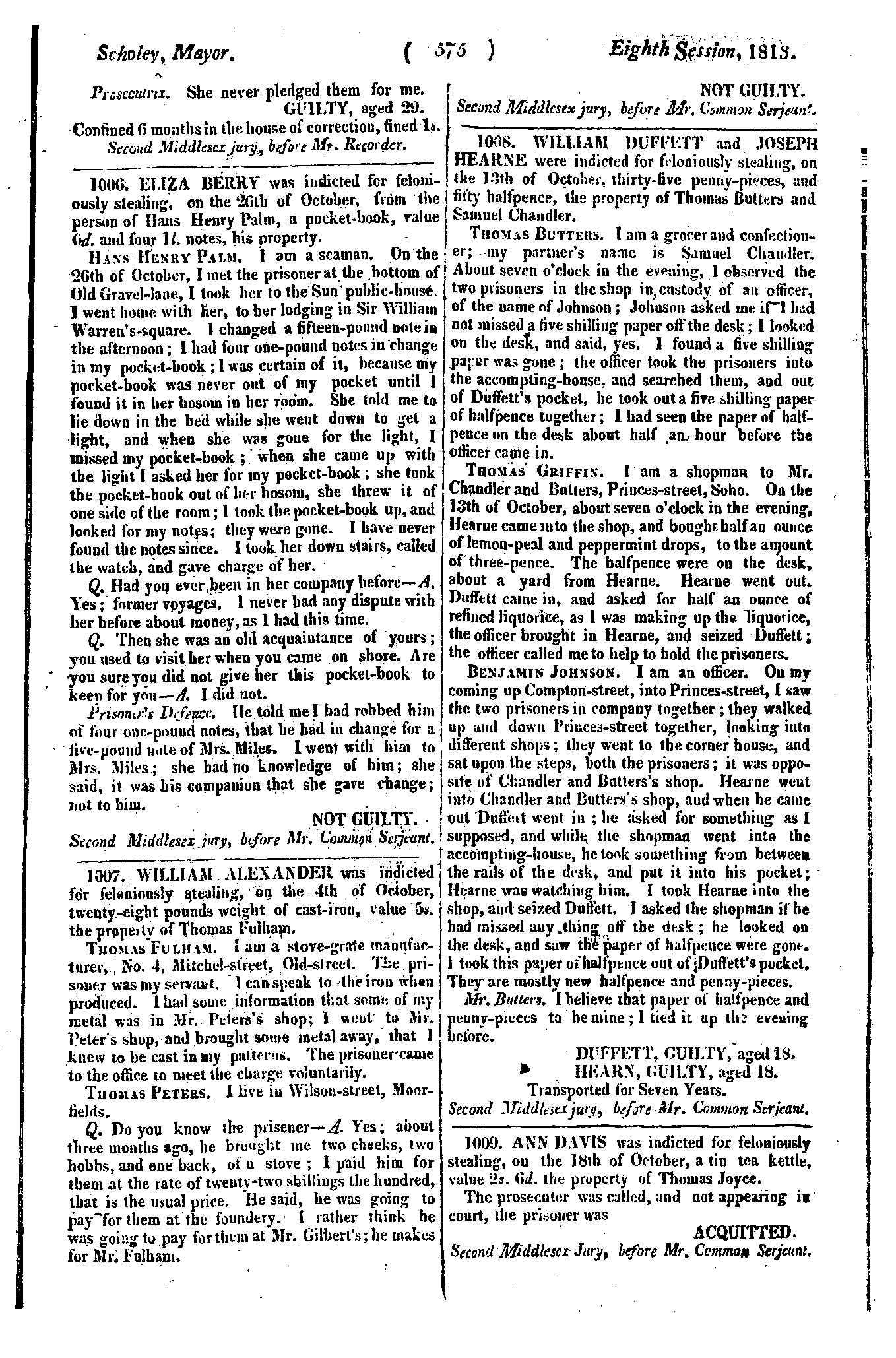
    Candler and Butters was operating as early as 1813. On 13 October 1813, 35 penny pieces and 50 halfpence [totalling 5 Shillings] were stolen from Samuel Chandler [sic] and Thomas Butters, grocers, in Princes Street, Soho. The culprits (William Duffett, and Joseph Hearner, both 18) were sentenced to be transported for 7 years. https://www.dhi.ac.uk/san/ob/1810s/181310270067.gif

    The London Gazette of 21 June 1814 listed Candler and Butters, grocers, Princes Street St James as creditors of Thomas Smith, subscription and coffee-room keeper, late of the Carlton Rooms, Princes Street, Leicester Square, and formerly of the Kent and Essex Tavern, Whitechapel (Middlesex), now in his Majesty’s gaol of Newgate.

    According to the London Gazette of 26 June 1821, Samuel Candler and Thomas Butters determined and dissolved their copartnership as Grocers and Confectioners, No 44, Princes-Street, Saint James’s, Westminster, by mutual consent on Saturday 23 June 1821.

    1841-1844

    The 1841 census shows Thomas (50, a confectioner) and Elizabeth (45) with children John (16, tobacconist), Elizabeth (14) and Ann (7) in Tufton Yard, Tufton Street (St John the Evangelist, Westminster).

    Thomas Butters (53, confectioner) died at 3 am on 24 October 1844 at 52 Great Felton [?] Street. The cause was apoplexy, 1st attack, 18 hours. Informant: John Butters, present at the death, 59 Rochester Street [illegible words underneath] Thomas Butters (53), of 52 Marsham Street (St John, Westminster) was buried on 30 November 1844 at All Souls, Kensal Green (west London).

    After 1844

    Elizabeth might be a 51-year-old widowed nurse (born in London) who in 1851 was at 8 South Grove, Peckham (southeast London) in a household headed by Alexander Booke Mills (a Scotch and Manchester warehouseman).

    Elizabeth Butters [nee Hunt] of 54 Red Lion Street (Clerkenwell) died on 24 February 1858. (Her daughter Ann had been lodging at 54 Red Lion Street in 1851). Probate was granted to Thomas Ebenezer Hunt, son.

    Thomas Butters and Elizabeth Hunt’s children

    Thomas and Elizabeth’s children were:

    • Thomas Ebenezer Butters (1817-1909)
    • Sarah Elizabeth Butters (1820-1903)
    • John Butters (1825-1858)
    • Elizabeth Butters (1827-1896)
    • Emma Butters (1829-1920)
    • Ann Butters (1834-1881)

    Thomas Ebenezer Butters (1817-1909)

    In 1841, a Thomas Butters (20, manufacturer of plate glass) and Emma Butters (10) [presumably his sister] were in Basing Place, Lambeth (south London) with female servant Helen Artley (20).  

    Marriage to Ann Jones

    Thomas Ebenezer Butters married Ann Jones on 6 April 1844 at Christ Church, Southwark (central London). The groom was an optician of 52 York Road, son of Thomas Butter, confectioner. Ann (of 138, Fleet Street) was a daughter of George Jones (mason). Bride and groom were of full age and single and signed with their names, as did the witnesses (William Simmons, Elizabeth Simmons and Sarah Simmons).

    In 1851, Thomas (optician, parallel glass worker) and Ann (born in Shrewsbury, Shropshire) were at 4 Belvedere Crescent (Lambeth) with 3 children and with Thomas’s sister Sarah (no occupation listed, born St Anne Soho) and brother John (wholesale tobacconist’s warehouseman, Westminster St James).

    Thomas and Ann had 3 children: Eleanor (1847-1915); Caroline (1849-?); and Thomas Edwin (1851-1936).

    2nd marriage

    Ann Jones died in 1860 and was buried in Norwood Cemetery, Lambeth [south London]. In 1864, Thomas remarried, to Clara Evenett:

    • Ada Florence Butters was born on 14 February 1865 at 4 Belvedere Crescent, daughter of Thomas Ebenezer Butter (optician (master)) and Clara Butters (formerly Evennett), informant: Thomas E Butters, father, 4 Belvedere Crescent, Belvedere Road (Lambeth).
    • Clara Butters (34) of Belvedere Crescent, Belvedere Road (Lambeth) was buried at Norwood cemetery on 2 June 1866.

    Address and occupation

    Thomas lived at: 4 Belvedere Crescent (Lambeth) (1851, 1861, 1871), then in Putney (west London) at 16 Victoria Road (1881, 1891) and then 2 Redgrave Road (1901).

    His occupation was said to be optician (1851, 1871) or parallel glass worker (1881, 1891) but by 1901, he was ‘living on own means’. He was employing 2 men in 1871 and 1881. The family had a female servant in 1871, 1881 and 1891 (different women in each case).

    Thomas (still of 2 Redgrave Road, Putney) died on 1 April 1909 and probate was granted to Ada Florence Butters [daughter] and Henry Smyth Stacy, printer. His effects were £4,186 17 s 5 d.

    Sarah Elizabeth Butters (1820-1903)

    Sarah Elizabeth Butters (1820-1903) never married. She lived in the same household as her brother Thomas Ebenezer Butters (1817-1909) until her death. 

    Sarah Elizabeth Butters of Faskally [?], Redgrave Road, Putney (Surrey) died on 11 December 1903 and was buried on 17 December at Norwood cemetery. Probate was granted to Thomas Ebenezer Butters [her brother] and Ada Florence Butters [niece].

    John Butters (1825-1858)

    John (a tobacconist) was with his parents Thomas and Elizabeth in 1841. In 1851, he was a wholesale tobacconist’s warehouse man, living with his brother Thomas Ebenezer (and Thomas’s wife and children) and their sister Sarah.

    John, a tobacconist (late of 146 Leadenhall Street, city of London) died on 28 August 1858 at 7 Englefield Road, Kingsland, Middlesex. Probate was granted to his brother, Thomas Ebenezer Hunt (parallel glass worker, of 4 Belvedere Crescent, Belvedere Road, Lambeth). John was buried at Norwood cemetery on 3 September 1858, aged 33.

    Elizabeth Butters (1827-1896)

    In 1851, Elizabeth was visiting Rebekah Glenn (72, born in St Mark’s, Lincoln; proprietor of houses and annuitant) at 10 Tufton Street. Tufton Street was where Thomas and Elizabeth Butters and 3 of their children (including Elizabeth) had been in 1841, and Rebekah was also there in 1841.

    1861 Elizabeth (a tobacconist’s assistant) was with her married sister Ann (and Ann’s husband and child) and widowed sister Emma (a shop woman) at 117 Packington Street, Islington.

    After 1861, Elizabeth was a domestic servant (cook):

    • with Francis Gompertz (48, architect) and his wife at 36 Bessborough Street, Westminster (1871)
    • with Francis’s brother Richard J Gompertz at Marquis Villas, St Margarett’s Road, Isleworth (west London). Richard was a British subject born in France and living on income from dividends (1881) or ‘on his own means’ (1891).

    The death of an Elizabeth Butters (70) was registered in Wandsworth in 1896.

    Richard Gompertz died in 1900 and the 1901 census shows Marquis Villas occupied by Francis Gompertz and his wife (and their domestic servants).

    Emma Butters (1829-1920)

    Emma Butters married Bene Hood (1814-1855) at St John the Evangelist, Lambeth on 7 October 1847. His father Bene Hood (baker), her father Thomas Butters, grocer. Both single of full age and of [illegible] Street. All signed with names. Witnesses [illegible] and Elizabeth Hohne [?].

    In 1851, Bene Hood (a baker, born in Newington, Surrey) and Emma were in Walworth (south London) with 2 young sons (William and Walter).

    After Bene Hood’s death in 1855, the widowed Emma was:

    • in 1861, a shop woman with married sister Ann (and Ann’s husband and child) and widowed sister Emma at 117 Packington Street, Islington.
    • in 1871 matron at Royal Hospital for Deformities, 315 Oxford Street (central London). It looks as though this was one of the forerunners of the Royal National Orthopaedic Hospital, but I haven’t been able to confirm this. https://en.wikipedia.org/wiki/Royal_National_Orthopaedic_Hospital  
    • in 1881 Matron of Borough Hospital, Western Road, Birmingham (Warwickshire). It seems this hospital was opened in 1852 as part of the Birmingham Union Workhouse, later becoming the Workhouse Infirmary, Dudley Road Hospital and then City Hospital. 
    • in 1891, lodging-house keeper with daughter Hannah Elizabeth Hood (assistant) at 5 Wellington Road, Deal (Kent).
    • in 1901, possibly Emma Hood, 73, born in NK [not known], London, occupation: ‘small means’, lodging at 162 Great College Street, St Pancras.  [Hannah Elizabeth Hood not found in 1901]
    • in 1911 at Eversleigh, Ravenscourt Park, Deal, letting apartments with Hannah (whose occupation was ‘upholstery-work’).

    The death of Emma Hood (age 91) was registered in 1920 in Eastry (Kent, the registration district which includes Deal).

    In 1921 Hannah Elizabeth Hood (69, apartment letting) was at 9 Ravenscroft Road (Deal) with visitors [her nieces] Lillian Louisa Hood (39, dress maker) and Ada Elizabeth Hood (38, upholsterer)

    Ann Butters (1834-1881)

    In 1851, Ann was lodging at 54 Red Lion Street with Leopold Amelang and family. (Ann’s mother Elizabeth was living at that address when she died in 1858).

    Ann married John (or Johann) Ludwig Frank (1826-1873) at All Saints, Lower Marsh, Leake Street, Lambeth (Surrey) on 26 October 1858. He was a pocket book maker of 146 Leadenhall Street, son of John Ludwig Frank, glazier. Her father: grocer. Her residence: Belvedere Crescent. Witnesses Thomas E Butters and Sarah Butters. All signed with names.

    In 1861, with husband (tobacconist, pocket book maker, born in Germany) and oldest child, and with her married sister Ann and widowed sister Emma (a shop woman) and unmarried sister Elizabeth (tobacconist’s assistant) at 117 Packington Street, Islington.

    In 1871 Ann and Johann Ludwig (fancy leather maker) were at 24 Tibberton Square (Islington) with 3 children. The widowed Ann (a bottler of chemicals) was still at 24 Tibberton Square in 1881 with the 3 children: Charles (a clerk), Louisa (artificial flower mounter) and Herbert (carpenter).

    The death of Ann Frank (47) was registered in Islington in 1881.

    Notes on identifying this family

    For the following reasons, I am confident that Thomas and Elizabeth Butters and Elizabeth discussed in this post are Thomas Butters (1790-1844) and Elizabeth Hunt (1796-1858), and that the 6 children are all theirs:

    • birth records for the couple’s 1st and 2nd children (Thomas Ebenzer Butters on 8 September 1817 in Carlisle Street, parish of St Ann Soho) and Sarah Elizabeth Butters on 22 March 1820 in Frith Street (also St Ann Soho) describe Elizabeth Butters as daughter of John and Sarah Hunt.
    • Thomas is consistently described as grocer and /or confectioner in the baptism records (1817, 1820) and marriage certificates of his children.
    • the grants of probate to Thomas Elizabeth Butters for his mother Elizabeth and brother John (both in 1858) describe him as Elizabeth’s son and John’s brother.
    • Thomas, Elizabeth and 3 of their children (Elizabeth, John, Ann) were all together in 1841.
    • In 1861, 3 of the children (married Ann, widowed Emma and single Elizabeth) were all together. And Sarah Elizabeth (who never married) was with her brother Thomas Ebenezer from at least 1851 for at least 50 years.

    DNA

    I have a small DNA match (1 segment of 16 centiMorgans) with a 3x great grandchild of Emma Butters (1929-1920) and Bene Hood. That 3x great grandchild also shares DNA matches:

    • of 32 cM (a segment of 21 cM and a segment of 11 cM) with a descendant of my 2x great grandparents William John Butters (1843-1906) and Emma Elizabeth Cummings (1862-1946).
    • of one segment of 23 cM with a descendant of my 3x great grandparents James David Butters (abt 1814 -1855) and Esther Ann Withers (abt 1815-1885), through their daughter Sarah Elizabeth Butters (1852-1923).
      I have discussed before whether this Sarah Elizabeth Butters could be related to Sarah Elizabeth Butters (1820-1903), daughter of Thomas Butters (1790-1844. https://birdsofcressingham.wordpress.com/2025/01/03/two-women-called-sarah-elizabeth-butters/

    It is conventional to measure the length of segments of DNA in centiMorgans (cM). If a matching segment is more than 10cM-20cM, it is quite likely to be inherited from a common ancestor only a few generations back.

    No other ancestors of the 3x great grandchild of Emma Butters (1829-1920) have any obvious links with my ancestors. So, I presume the shared DNA—shared by that person, by me and by the 2 descendants of my 3x great grandfather James David Butters—comes from some ancestor shared by Emma’s father (Thomas Butters,1790-1844) and by James David Butters.

    Who was Thomas Butters’s father and was he related to my ancestors?

    The DNA links above suggest that Thomas Butters (1790-1844) was related (maybe closely) to my 3x great grandfather James David Butters (abt 1814-1855).

    Thomas Butters

    Thomas Butters was born in 1787-1791 (according to the 1841 census) or 1790-91 (according to a bishop’s transcript of the death register). He may be a Thomas Butters who received a Baptist baptism on 14 December 1790, son of James Butters (died 1821) a brazier of St Mary Le Bone (Marylebone, central London) and his wife Mary, who were living in Marylebone Lane. James and Mary were perhaps James Butter and Mary Jones who were married at St James, Piccadilly on 29 April 1779. https://birdsofcressingham.wordpress.com/2021/08/24/will-of-james-butters-brazier-1821/

    Thomas Butters (1790-1844) had an elder brother James, born to James and Mary on 21 February 1785. Their births are recorded in the parish register of Christchurch Baptist church Southwark.

    Church Street Baptist meeting house
    The cover sheet for the birth register describes it as the register for the Church Street Baptist meeting house, founded in 1785, with the register kept by Mr Upton from the Church’s foundation in 1785 until his death in 1843. A note inside the register describes it as the Baptist Church meeting in Green Walk, in the parish of Christ Church Surrey, under the pastoral care of James Upton. https://www.rootschat.com/forum/index.php?topic=897228

    James Upton was for 48 years from 1786 (until his death in 1834) pastor of the Baptist church, Church Street (then called Green Walk), Blackfriars Road, London. https://www.baptists.net/history/2023/07/the-life-and-ministry-of-james-upton/

    James David Butters

    My 3 x great grandfather James David Butters was born around 1815 and died in 1855. Zinc worker who died young – Birds of Cressingham

    James may have been James David Butters, who was baptised on 10 October 1814 at St James Piccadilly (central London). The parents were James (chimney improver) and Ann Butters, living in Market Row. I discuss below the following people who might be James Butters (the chimney improver):

    • James Butters (baptised 1785), son of James and Mary Butters
    • James Butters (abt 1779-1838)
    • James Butters (1785-1837), who married Rebecca Hammersley in 1820
    • James Butters, who married Elizabeth Cordell in 1807
    • James Butters, who married Ann Thomas in 1797  

    James Butters (baptised 1785), son of James and Mary Butters

    James Butters was baptised in 1785 and was brother of the Thomas Butters (1790-1844) discussed in this post. The following facts make it plausible that he could have been James David Butters’s father:

    • his age: he would have been about 29 when James David Butters was baptised;
    • the DNA matches between (a) a descendant Thomas Butters (1790-1844) and (b) me, and 2 other descendants of James David Butters.
    • James David Butters’s middle name: James Butters (baptised 1785) and Thomas Butters (1790-1844) had a short-lived brother David (1787-89). Perhaps he is commemorated in the boy’s middle name. (Middle names were not yet very common in the early 19th century and David doesn’t seem to be a particularly common name.)

    The father of this James and Thomas was also James Butters, probably James Butters a brazier who died in 1821. It is just about possible that James Butters the brazier had a 2nd wife called Ann and that they together had a son in 1814 (James David Butters). If so, that would explain the DNA matches. On the other hand, James’s will mentions a son James but not a son James David—it seems likely that James senior would have mentioned James David if James David was his son.  

    James Butters (abt 1779-1838)

    James Butters (59) of 3 Princes Court, Whitcomb Street, died on 25 June 1838 of consumption. The informant was [the mark of] Elizabeth Pullen, 3 Princes Court, present at the death.

    Whitcomb street runs north from Pall Mall, running just southwest of the southwest corner of Leicester Square. In 1816 and up until 1821, Thomas Butters (1790-1844) and his partner Samuel Candler were running the grocery firm of Candler and Butters in Princes Street, Leicester Square.

    I haven’t been able to track down the exact location of Princes Street (Leicester Square) and Princes Court (Whitcombs Street), but they were presumably close to each other. Perhaps their proximity is another clue that Thomas Butters was a brother of James Butters (1779-1838).

    Elizabeth Pullen

    The person who registered the death of James Butters (1779-1838) was Elizabeth Pullin [or Pullen] of Princes Court. The 1841 census shows Elizabeth Pullen (55) and William Pullin (60, bootmaker) in Princes Court. Where they related to James Butters?

    The 1851 and 1861 censuses say William was born in Petworth (Sussex) in 1779 and the 1851 census says Elizabeth was born in Amberston (Derbyshire—possibly Ambaston or Embaston) in 1780. Possible marriages are to Elizabeth Spencer in St Ann (Soho) in 1805 and Elizabeth Wright in St Martin on the Fields (1827).

    I don’t know of any connection between James Butters and William or Elizabeth Pullin.  

    James Butters (1785-1837), who married Rebecca Hammersley in 1820

    James Butters (1785-1837) married Rebecca Hammersley in 1820 at St Martin in the Fields (central London).

    The parish register of marriages and banns doesn’t record whether James and Rebecca were single or widowed. If James was widowed, perhaps he was the same man whose son James David Butters (son of Ann) was baptised in Piccadilly in 1814.

    The following facts make it plausible that James Butters (1785-1837) could have been James David Butters’s father:

    • his age: he would have been about 29 when James David Butters was baptised;
    • his birth date: according to the death records, he was born in 1785, which means he could be James and Mary Butter’s son baptised in that year.

    On the other hand, one important fact makes it seem unlikely that James Butters (1785-1837) was James David Butters’s father. Rebecca Hammersley and a James Butters had a short-lived son James Hammersley Butters in 1812, 8 years before their marriage.

    If this was the same couple, it seems unlikely that the same James Butters had a son (James David Butters) with another woman (Ann) in 1814—2 years after the birth of James Hammersley Butters and 8 years before James’s marriage to Rebecca.  https://birdsofcressingham.wordpress.com/2021/08/24/will-of-james-butters-brazier-1821/

    James Butters, who married Ann Thomas in 1797 

    James and Ann Butters might be James Butters (a widower of St Mary-le-Bone) and Ann Thomas who married at Christ Church, Southwark on 12 February 1797 by licence. I don’t know where Ann was living and I know nothing about James’s 1st wife.

    The following facts contradict the idea that James and Ann Butters were the couple who married in 1797:

    • James David Butters wasn’t baptised until 17 years after that marriage and I have found no other child of James and Ann Butters. It seems unlikely that they had no children in 17 years. Of course, they could have had earlier children who died young, but it seems reasonable to assume that I would have come across some record of at least one earlier child if they existed.
    • Thomas Butters’ brother James was baptised in 1785. He would have been about 29 in 1814, so he could be the father of James David Butters. But it is unlikely that he married Ann Thomas in 1797, when he would have been about 12.

    James Butters, who married Elizabeth Cordell

    A James Butters married Elizabeth Cordell at St Andrew Holborn on 29 March 1807. Perhaps he was one or more of the following people:

    Conclusions

    In the light of the information discussed above:

    • it seems likely that Thomas Butters (1790-1844) was a son of James Butters (died 1821) a brazier of Marylebone and his wife Mary. It seems plausible that this couple were James Butter [sic] and Mary Jones who married in Piccadilly in 1779.
    • it seems likely that Thomas Butters (1790-1844) was related to my 3x great grandfather James David Butters (abt 1814-1855).
    • it seems likely that James David Butters (abt 1814-1855) was the son of James Butters (a chimney improver) and Ann Butters, baptised in Piccadilly in 1814. It is plausible that James Butters (the chimney improver) was the brother of Thomas Butters (1790-1844), James Butters (baptised in Southwark in 1785).
    • James Butters (the chimney improver) may be James Butters (abt 1779-1838) who died in Princes Court, Whitcomb Street in 1838.
    • it seems unlikely that James Butters (the chimney improver) was the James Butters (1785-1837) who married Rebecca Hammersley in 1820 and who seems to have had a short-lived son (James Hammersley Butters) with her in 1812.
    • it seems highly unlikely that the James Butters (widower of St Mary-le-Bone) who married Ann Thomas in Southwark in 1797 was any of the following people:
      (a) the son (baptised in 1785) of James Butters and Mary Jones;
      (b) James Butters (1785-1837); or
      (c) James Butters (the chimney improver) whose wife Ann was the mother of James David Butters (baptised in 1814).
    • James Butters who married Elizabeth Cordell in Holborn 1807 could have been the same person as any of the other men discussed in this post, but I know nothing else about James and Elizabeth.
    • perhaps James Butters (the chimney improver) was not any of the other people discussed in this post. I have not (yet) found any records of any other James Butters living in London around 1814.

    Overall, the most likely hypothesis seems to be that:

    • my 3 x great grandfather James David Butters (abt 1814-1855) was baptised in Picadilly in 1814, son of James Butters (chimney improver) and Ann.
    • James Butters (chimney improver) was a son of James Butters and Mary Jones, and brother of Thomas Butters (1790-1837). He may be the 59-year-old man who died in Princes Court, Whitcomb Street in 1838.

    Follow up

    I would like to find some evidence that helps answer the following questions:

    • were any other boys called James David Butters born in London around 1814?
    • were any men called James Butters (apart from the men discussed in those post) in London around 1814?
    • what was the maiden name of Ann (mother of James David Butters), when and where did she marry James Butters (the chimney improver) and where and when was she born?
    • where did James and Ann Butters live before and after 1814, and did they have any other children?
    • who was the James Butters (59) who died in Princes Court, Whitcomb Street in 1838?
    • what happened to James Butters and Ann Thomas after their marriage in 1797?
    • who was the James Butters who married Elizabeth Cordell in 1807 and what happened to them after their marriage?
    • the Poor Law Committee for St James Piccadilly ordered 7 shillings to be paid to James Butters between 14 and 28 November 1821. Who was he?

    It would also be helpful to get more DNA evidence from:
    – further people getting their DNA tested; and/or
    – people uploading their Ancestry DNA test results to Gedcom, to show the precise location of the DNA matches (which chromosome(s) and which places on the chromosome(s)). Uploads to Gedcom are free.

    Even better information is possible by using My Heritage (rather than Gedcom). Unfortunately, My Heritage recently stopped accepting uploads from Ancestry, so the only way to make use of My Heritage is now to buy a test from them.

    Who were James and Ann Butters?

    My 3 x great grandfather James David Butters was born around 1815 and died in 1855. James may have been James David Butters, who was baptised on 10 October 1814 at St James Piccadilly (central London). The parents were James (chimney improver) and Ann Butters, living in Market Row. Zinc worker who died young – Birds of Cressingham https://birdsofcressingham.wordpress.com/2020/09/14/zinc-worker-who-died-young/

    The date, the use of the same name and the uncommon use of a (not particularly common) middle name suggest this could be the same person. But on the other hand, although not too far away, this is not the same parish as where he lived later.

    If may ancestor was the James David Butters wo was baptised on 10 October 14,

    Who were James and Ann?

    I have found one record of a James Butters marrying an Ann around the right time for this to be the couple who had son James David baptised in 1814. James Butters of St Mary-le-Bone (a widower) married Ann Thomas at Christ Church, Southwark on 12 February 1797 by licence. The marriage register is damaged and so some information is lost or illegible:

    • Ann Thomas’s marital status and parish of residence;
    • name of the church official conducting the ceremony; and
    • whether James and Ann signed with their names or just with a mark. Their first names and part of their surnames are visible, but I can’t quite decide whether the writing differs enough to show whether the signatures were written by the person who wrote the rest of the entry.

    The witnesses were Ann Danck [?] [or Ann Banch?] and Joseph Barrett, who both signed with their names.

    There is a squiggle between James and Butters in the first line. It isn’t clear whether that is meant to be a middle initial, just a flourish at the start of the capital B or is just some mark on the paper.  

    New information

    The interesting new information is that James was a widow. I haven’t yet found a suggestion for who his 1st wife could have been.

    Conclusions

    Paddington / Lisson Grove / Marylebone  are not that far from where my 3 x great grandfather James David Butters lived later. That fact, and the middle name and baptism date make it seem reasonably likely that my 3 x great grandfather was the same James David Butters who was baptised on 10 October 1814 at St James Piccadilly, to James and Ann Butters.

    I have found only one marriage of a James Butters and an Ann: in Southwark in 1797 between James Butters (widow) and Ann Thomas (marital status unknown). That could be the right couple, but I have found no more evidence to confirm (or disprove) this idea.

    I still don’t know whether James Butters (father of James David Butters, baptised 1814) was any of the following people:

    Two Povey husbands for Sarah Brind, or just one?

    Sarah Harriet Brind (1867-1943) married William Albert Edward Povey (born 1863) in 1884 and had 8 Children with him up to 1902. She then had 3 children with Henry Povey (1867-1918) between 1905 and 1910. She emigrated to Australia with her 2 youngest children in 1920.

    I haven’t found any record of William Povey’s death or of a marriage between Sarah and Henry. Were Willliam and Henry really 2 different people, or did William just change his name? And if they were different people, was Henry William’s brother?

    I discuss below:

    • Sarah Harriett Brind
    • William Albert Edward Povey
    • Sarah and William’s life together
    • Henry Povey
    • Sarah’s emigration to Australia
    • Sophia Brind (Sarah’s illegitimate daughter)
    • DNA evidence
    • Conclusion

    Sarah Harriett Brind

    Sarah Harriett Brind was born on July 31 1867 in Hillingdon (Middlesex), daughter of Thomas Brind (a labourer) and Sophia (née Wild). In 1871, the family were in Liphook (Hampshire).

    On 9 August 1876, Sophia was admitted to Hillingdon Workhouse with children Sarah, John, Matilda and Elizabeth, and discharged the next day. According to the admission and discharge book, she had been deserted by her husband and had ‘bad eyes’.

    In, 1881 Sarah Brind was at 6 Little Church Place, Queens Park (north west London) with her mother Sophia Brind (widow, 38), Samuel Snook (40, labourer, Somerset), Sarah Brind (13, Uxbridge), Eliza Brind (6, Uxbridge) and Anne Snook (1, Uxbridge). Was Anne Snook a daughter of Samuel Snook and Sophia Brind? As I have written before, my 2 X great grandparents Charles Povey and Elizabeth Herbert were living in 1881 at 2 Little Church Place, near several relatives. Charles Povey was an uncle of William Albert Edward Povey. https://birdsofcressingham.wordpress.com/2022/04/16/church-place-near-kensal-town/

    William Albert Edward Povey

    William Albert Edward Povey was born in Poplar (east London) on 10 March 1863 and baptised on 17 April 1864 at all Saints, Poplar. His father William Henry Povey was an engineer, his mother was Emily Sophie Povey [née Harrison] and the family were living at 5 Bath Place.

    William Henry Povey (1839-1911?) was a son of my 3x great grandparents William Povey (1810-1995) and Mary Ann Jauncey (1811-1864 https://birdsofcressingham.wordpress.com/2020/11/07/william-povey-1810-1895/

    As I have mentioned before, William Henry Povey (1839-1911) and his brother John Povey (1842-1920) both had a child baptised on the same day (10 September 1865) at All Saints, Poplar: William’s son Thomas and John’s daughter Florence Mary. https://birdsofcressingham.wordpress.com/2024/07/31/baptised-on-the-same-day-3/

    In 1871, William Povey (8) was at 11 Warrington Street (Poplar) with his parents (father a engineer-fitter) and 3 siblings (including brother Henry, born in Poplar in 1867). I haven’t found William or his brother Thomas in 1881. In 1881, his mother Emily (an ironer), brother Henry (13) and sister Emily (9) were at 4 Edenham Street, Kensington.  Brother Edward (11) may have been a boy who was at Upton House Truant School, Urswick Road, Hackney.

    Sarah and William’s life together

    William Albert Edward Povey (of College Park, 20, labourer, son of William Povey, Engineer) married Sarah Harriet Brind (of Harlesden, 19, daughter of Thomas Brind, labourer) on Christmas Day, 1884 at St Mary, Willesden (northwest London). The witnesses were Samuel Snook (presumably the main who was in the Brid household in 1881) and Ann [?] Daggrell. The bride, groom and witnesses signed with their names.

    In 1891, William and Sarah were at 54 High Street, Brentford with children Sophy [Sarah’s daughter Sophia Brind, see below], Emily, Rosey and Phoeby [sic]. William was a labourer.

    In 1901, William and Sarah were at 55 Windmill Road, Old Brentford with children Emily (house maid), Rosy and Phoebe again, as well as new children William, Henry, Ethel and Vera. William was a railway wagon repairer. According to the 1901 census, they’d had 7 children. I haven’t found Sophia Brind (or Povey) in 1901.

    William and Sarah were still at 55 Windmill Road on 20 July 1902, when their son Albert Edward Povey was baptised. William was a waggon repairer in both 1901 and 1902.

    I haven’t found a death record for William or any sign of him after the census in 1901 and the birth record (and baptism) in 1902.

    In 1911, a William Povey (56), a painter born in Marylebone was in Paddington Infirmary, 285 Harrow Road, Paddington. He had been married 30 years and had 11 children (5 still living). This seems to be a different person.

    Henry Povey

    In 1905, 1908 and 1909, Sarah had 3 more children (Herbert Victor, Frederick and Jack). The father was Henry Povey, a house painter’s labourer. The family were at 8 Clifton Street (Hammersmith, 1905), 8 Hall Place (1908) and 54 Amberley Road (1909).

    In 1911 (39), Henry Povey and his wife Sarah were at 45 Hampden Street, Harrow Road (Paddington) with children Bert (5), Fred (3) and Jack (1). Henry was a painter’s labourer (out of employment). The 1911 census says Henry and Sarah had been married (only) 7 years and had had (only) 3 children.

    Although the 1911 census says Sarah and Henry had been married 7 years, I haven’t found any record of a marriage between them, and I haven’t found Henry on the census in 1891.

    Harry Povey (aged 51), Private, Labor Corps, Painter of 161 Arlington Road, Camden Town, Middlesex died on 19 March 1918 in Kitchener’s Hospital, Brighton. Cause: 1. Aortic stenosis 99 days. 2. Oedema of lungs p.m. Certified Informant: AJ Henderson major CAMC, acting chief officer. Administration (with will) granted on 14 February 1920 to Sarah Harriett Povey, widow. Effects £213 0s 6d. Regimental Number 400542

    Who was Henry Povey?

    Harry’s age at death (51 in 1918—though slightly inconsistent with his reported age in 1911 [39]) is consistent with the birth of William’s brother Henry in 1867. A transcript of Soldiers Died in the Great War gives Henry’s name and death date, and says he was born in Poplar. Also, I have some DNA matches with some of Henry and Sarah’s descendants. I have no known DNA link with Sarah, so presumably Henry was a relative of my Povey ancestors.

    It could be that William just changed his name to Henry, but it seems more likely that Henry was a different person, perhaps William’s brother.

    Sarah’s emigration to Australia

    The electoral register shows Sarah Harriett Povey in 1920 at 161 Arlington Road, St Pancras. Henry had been residing there when he died.

    Sarah and sons Herbert V and Frederick left England on 25 September 1920 for Sydney (Australia). In 1930, Sarah Harriett Povey was at 5 Baldry Street, Chatswood, North Sydney. Sarah died in Chatswood in 1943.

    Willian and Sarah’s daughter Rosey (Rosina) married James Laurence Kelly (who appears to have been Australian) in 1916 and she emigrated to Australia in 1918.

    Sophia Brind

    Sophia Brind, daughter of Sarah Brind (domestic servant) was born on 30 January 1884 in Chelsea Workhouse. Sarah’s address was 2 Wedlake street, Kewlab [?], Kew. Sarah Brind, mother, (of Chelsea Workhouse, Arthur Street) registered the birth on 7 February 1884. Perhaps Sarah moved into the Workhouse for the birth.

    The birth certificate doesn’t name a father. The birth was just under 11 months before Sarah’s marriage with William Albert Edward Povey. Maybe he was the father, or maybe it was another man.

    Sophia appears to be Sophia Povey (29 January 1884-1965), who married Cesidio Palombo (1871? -1922) in 1909 and then George Bowles (1864-1939) in 1924. George Bowles was run over by a car (and died) during the blackout in 1939.

    DNA evidence

    My father had DNA matches with 1 descendant of William Albert Edward Povey and Sarah Harriet Brind and with 2 descendants of Sarah Harriet Brind and Henry Povey:

    • a match of 28.4 cM on chromosome 21 with person A: a great granddaughter of William and Sarah’s son Albert Edward Povey (born 1902).
    • a match of 29.4 cM (2 segments of 22.8 cM and 6.7 cM, both on chromosome 10) with person B: a granddaughter of Henry and Sarah’s son Herbert Victor Povey (1905-1976) through his son Robert Povey.
    • a match of 14 cM on chromosome 12 with person C: a great granddaughter of Herbert Victor Povey (1905-1976), through his son Edward Povey (1931-2000).

    The longer match on chromosome 10 and the matches on chromosomes 21 and 12 overlap with DNA matches with 2 or 3 people who I know descend from William Povey and Mary Ann Johncey. Also, person C and my father share matches with 9 people who descend from my Povey ancestors, though I don’t know which chromosomes host the shared matches

    It is conventional to measure the length of segments of DNA in centiMorgans (cM). If a matching segment is more than 10cM-20cM, it is quite likely to be inherited from a common ancestor only a few generations back.

    Matches between Person A and persons B and C

    Person A shares 105.1 cM of DNA with person A and 28.4 cM with person C. I considered whether whether William and Henry were more likely to be the same man, or more likely to be brothers.  I started by looking at the size of the match between persons A and B.

    DNA match between persons A and B

    If William and Henry were the same man, person A is a second cousin once removed of person B. The shared cM project reports that the average DNA shared by second cousins once removed is 122 cM, with a range of 14 cM to 353 cM. The shared cM tool is at https://dnapainter.com/tools/sharedcmv4

    On the other hand, if William was Henry’s brother, person A is person B’s half second cousin once removed (on the Brind side) and half third cousin once removed (on the Povey side). The shared cM project reports that the average DNA shared:

    • by half second cousins once removed is 66 cM, with a range of 0 cM to 190 cM.
    • half third cousin once removed is 37 cM, with a range of 0 cM to 139 cM.

    Thus, the average DNA shared by people with that relationship is presumably an average of 103 cM (66 cM + 37 cM) and a range of 0 cM to somewhere between 190 cM and 329 cM (190 cM + 139 cM). (The range is probably less than 190 cM + 139 cM because if a descendant inherited a DNA segment from the Brind side, presumably that fact reduces slightly the probability of inheriting a DNA segment in the same location from the Povey side.)

    The DNA match between persons A and B was 105.1 cM. That is slightly closer to (a) the average (103 cM) for half second cousin once removed (on the Brind side) and half third cousin once removed (on the Povey side) than to (b) the average for second cousins once removed (122 cM). But there’s not much in it.

    DNA match between persons A and C

    I turn now to the DNA shared between persons A and C. If William and Henry were the same man, person A is a third cousin of person C. The shared cM project reports that the average DNA shared by third cousins is 73 cM, with a range of 0 cM to 234 cM.

    On the other hand, if William was Henry’s brother, person A is person C’s half third cousin (on the Brind side) and half fourth cousin (on the Povey side):

    • the shared cM project reports that the average DNA shared by half third cousins is 66 cM, with a range of 0 cM to 190 cM.
    • the shared cM project reports no data on half fourth cousins, so presumably the average DNA shared between half fourth cousins is very low.
    • thus, the average DNA shared by people who are both half third cousin (on the Brind side) and half fourth cousin (on the Povey side) is an average of about 66cM with a range of about 0 cM to 190 cM.

    The DNA match between persons A and C was 28.4 cM. That is very slightly closer to the average (66 cM) for half second cousin once removed (on the Brind side) and half third cousin once removed (on the Povey side) than to the average for third cousins (73 cM).

    Other DNA tools

    I also looked at 2 other DNA tools. The Banyan tool https://www.banyandna.com/home and What are the Odds (WATO) https://dnapainter.com/tools/probability

    Banyan told me that person A was:

    • more likely to be person B’s half second cousin once removed (expected DNA shared 11cM-110 cM, average 47cM) than person B’s third cousin once removed (expected 2cM-58 cM, average 20cM). Persons A and B in fact share 105.1 cM.
    • more likely to be person C’s half third cousin (expected 1 cM-60 cM, average 20 cM) than person C’s fourth cousin (0 cM-34 cM, average 8 cM). Persons A and B in fact share 28 cM.

    I’m not putting much weight on this result, partly because Banyan’s description of the relationships is incomplete. Persons A, B and C:

    • all descend from Sarah Brind; and also
    • either (a) all descend from William Povey or (b) Person A descends from him and Persons B and C descend from his brother Henry.

    WATO considered both scenarios: one man (William and Henry were the same man) and two brothers (Henry was William’s brother). WATO suggested that the one man scenario was 17 times more likely than the 2 brothers scenario.  But WATO seems to give no way to build in the information that persons A, B and C all descend from the same woman. So that result may not be very reliable.

    Conclusions

    William Albert Edward Povey was a son of William Henry Povey (1839-1911) and Emily Sophia Harrison (1842-1907) and grandson of my 3 x great grandparents William Povey and Mary Ann Jauncey.

    William Albert Edward Povey married Sarah Harriet Brind in 1884 and had 8 children with her by 1902. Sarah then had 3 children from 1905 with a Henry Povey, who was with her in 1911 and died in 1918.

    Sarah emigrated in 1920 to Australia with her 2 youngest children. One of her other children also emigrated to Australia (in 1918).

    It seems most likely that William and Sarah separated (or William died) between 1901 and 1905 and that Sarah then started having children with William’s brother Henry. But I have found no records of William’s death or of a marriage between Sarah and ‘Henry’.

    Other possibilities are that William just changed his name between 1901 and 1905, or that Henry Povey was a different man but not William’s brother.

    Here is a summary of the evidence:

    • Henry’s ages on the 1911 census and his death certificate are more consistent with the birthdate of William’s brother Henry than with William’s own birthdate. Also, Henry’s occupation, as reported on the 1911 census and on the birth certificates of his 3 children was painter’s labourer, whereas William reported his occupation as just labourer and then as waggon repairer. Admittedly, a change in occupation is possible, but it seems more likely that these were 2 different men.
    • I have DNA matches with descendants of both William & Sarah and ‘Henry’ & Sarah, which suggests that Wiliam and ‘Henry’ were closely related to each other: either the same person, or, for example, brothers.
    • The size of the DNA matches between William’s descendants and descendants of ‘Henry’ suggest that it was slightly more likely that they were brothers than that they were the same man, but the evidence is weak.

    On balance, I think it is slightly more likely that Henry was William’s brother, and not just a pseudonym for William.

    Future research

    It would be helpful to turn up:

    • documents to show when William Albert Edward Povey died and whether Henry Povey and Sarah Harriet Brind did ever marry;
    • some more persuasive DNA evidence one way or the other.

    Edward and Ann Nelstrop of Thetford and Barningham

    In a recent post, I mentioned an index listing a settlement document dated 19 March 1759 relating to Edward Nelstrop and Ann Nelstrop, legally settled in Thetford (Norfolk), but presumably living in Barningham (Suffolk). https://birdsofcressingham.wordpress.com/2025/12/04/early-nelthorpes-near-hockham-and-wattisfield/

    Thanks to Sarah Whitehead (a descendant of Edward Nelthorpe (about 1794-1870) of Wattisfield (Suffolk)), I have now seen an image of the original settlement document, which confirms the information on the index but does not give me any new information.

    The document is signed by 4 Church Wardens and Overseers of the Poor of the Parish of St Peter Thetford and addressed to the overseers of Church Wardens and Overseers of the Poor of Barningham. The document acknowledges that Edward Nelstrop and his wife Ann were legally settled in the parish of St Peter, Thetford.

    Design a site like this with WordPress.com
    Get started